Dental Solutions of South Florida — Website Visual Reference Page 3 · Tongue Tie Frenectomy

Open Your Nasal Passages without surgery.
Nasal Release Therapy (NRT) uses a small, precisely placed balloon to gently release cranial restrictions from inside the nasal passages — opening the airway, restoring cranial mobility, and improving breathing in ways that surgery and medication alone often cannot achieve.
6–8 sessions typical — results are cumulative
Immediate sense of openness after each session
No surgery, no anesthesia, fully awake in the dental chair
Often the missing piece for chronic mouth breathers

Dr. Haller performing an NRT session
6–8
sessions in a typical course
Minutes
per session — in-office
0
days of downtime
A complement to the full airway plan
NRT is often used alongside arch expansion, tongue tie release, and myofunctional therapy — opening the nasal passages so nasal breathing becomes the path of least resistance.
Who it helps
Conditions NRT addresses
Chronic nasal congestion
Persistent obstruction that hasn’t resolved with medication, sprays, or allergy management.
Mouth breathing
Makes nasal breathing the path of least resistance again — often the missing piece in an otherwise complete airway plan.
Deviated septum symptoms
A non-surgical option worth trying before committing to septoplasty or turbinate surgery.
Chronic sinusitis & pressure
Drainage and pressure relief that is often immediate — sometimes within minutes of the first session.
Sleep-disordered breathing
Opens the upper airway as part of a comprehensive airway plan including expansion and tongue posture work.
Headaches & facial pressure
Releasing restricted cranial sutures often provides rapid relief from chronic headaches and facial tension.
Understanding the treatment
What is Nasal Release Therapy?
A gentle, precise technique in which a small, lubricated balloon is inserted into the nasal passage and briefly inflated. This creates a controlled expansion that releases restrictions in the cranial bones surrounding the nasal cavity. The technique has been used for decades in chiropractic and naturopathic medicine and is now being integrated into airway-focused dental practice.
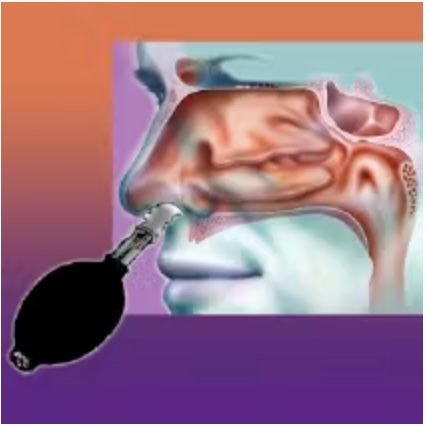
How it works — the mechanics
A small latex finger cot coated in water-soluble lubricant is attached to an inflation bulb and gently inserted into a nasal meatus — the spaces between the nasal turbinates. When briefly inflated, the balloon expands posteriorly past the firmer facial and cranial bones into the softer tissues of the nasopharynx. The patient will hear or feel a “pop” or “click” — the sound of cranial bones releasing at the suture lines. The balloon deflates immediately. The process takes only seconds per nostril and is repeated across different meatus positions in a specific sequence.
Why the nasal passage is the access point
The nasal cavity is surrounded by some of the most important bones of the skull — the sphenoid, vomer, ethmoid, palatine, and maxillary bones. These bones are directly accessible from inside the nose. When they are restricted or misaligned, the effects ripple through the entire cranial system. NRT reaches these bones directly — without surgery, without incision, and without general anesthesia.
The science behind NRT
Your skull is not one solid bone — and that matters
Most people picture the skull as a single rigid helmet. In fact, it is composed of 22 bones connected by flexible sutures — joints that allow subtle, rhythmic motion throughout life. When these sutures become restricted or jammed, the consequences reach far beyond the head.
The cranial rhythm & CSF connection
The brain and spinal cord are bathed in cerebrospinal fluid (CSF), which pulses in a slow, rhythmic cycle. Normal cranial suture mobility supports this rhythm. When sutures are jammed — by trauma, birth compression, or chronic tension — CSF flow may be impeded. Research has linked altered cranial motion to chronic sinusitis, headaches, brain fog, mood disturbances, and sleep disruption. NRT restores mobility to restricted sutures, often with immediate effects on how patients feel and breathe.
Why restrictions develop
Adult head & facial trauma
Car accidents, falls, sports injuries, and facial fractures can jam cranial bones in ways that never fully resolve — even after the acute injury heals. The result is often a constellation of symptoms patients and physicians struggle to connect: persistent headaches, tinnitus, brain fog, visual disturbances, facial asymmetry, and chronic nasal obstruction. NRT can release these restrictions years or even decades after the original injury.
Common sources of cranial restriction
- Car accidents — whiplash compresses the cranial base
- Sports concussions — repeated low-grade impacts accumulate
- Nasal fractures — direct restriction at the nasal bones
- Falls — especially onto the face or back of the head
Birth trauma — even natural delivery
Passing through the birth canal applies significant compressive forces to the cranial base. The bones are designed to overlap temporarily — but they don’t always fully decompress afterward. Forceps or vacuum delivery increases this substantially. These restrictions can persist throughout life without anyone connecting them to ongoing symptoms.
Signs of birth-related cranial restriction
- Asymmetrical head shape or strong head-turning preference
- Latch difficulty, excessive crying, difficulty settling
- Chronic nasal congestion from birth
- Facial asymmetry visible from infancy
Facial asymmetry — a visible sign worth noting
One eye higher than the other. A nose that trends to one side. An uneven jaw or cheekbones. A chronic head tilt. These are often outward expressions of cranial bone misalignment — and many patients find their features gradually becoming more symmetrical as restrictions release with NRT.
Research support
Documented since the 1940s
The nasal specific technique has been documented in chiropractic literature since the 1940s. A 1995 case study published in the Journal of Manipulative and Physiological Therapeutics documented significant relief from chronic sinusitis and sinus headaches — with improvements in post-nasal drainage, visual acuity, sense of smell, sense of taste, and ease of breathing.
Does this sound familiar? NRT may be worth exploring if you have:
- A trauma history — car accident, sports concussion, fall, nasal fracture, or significant dental work involving force
- A difficult birth — long labor, forceps or vacuum delivery, or asymmetrical features from birth or infancy
- Unexplained symptoms — chronic headaches, tinnitus, brain fog, facial asymmetry, or nasal obstruction that hasn’t responded to other treatment
“I began using NRT because I was seeing patients whose nasal breathing wasn’t responding to expansion alone. Once I understood that many of them had cranial restrictions from old injuries or difficult births, NRT became an essential part of what I offer. The results are often immediate and sometimes quite dramatic.”
— Dr. Leslie Haller, DMD
The experience
What to expect — before, during, and after
NRT is unlike anything most patients have experienced before. Knowing what to expect makes the experience much more manageable — and helps patients understand why the sensation, though unusual, is not harmful.
The honest description — what it actually feels like
Dr. Haller describes NRT as feeling a little “creepy” — having a balloon inserted into the nose is an unfamiliar sensation, and the brief inflation pressure can be startling, similar to the feeling of aspirating water into the nasal passage. The first session tends to be the most uncomfortable. Successive treatments are progressively more tolerable as the cranial bones begin to open up. Most patients feel immediate relief after each session — often a sudden sense of openness in the nasal passages and head. Treatment is cumulative: each session builds on the last.
1
Preparation
The nasal passages are lubricated. A small balloon on an inflation bulb is prepared. No anesthesia. Patient is fully awake and seated in the dental chair.
2
Insertion
The balloon is gently guided into the nasal meatus — the space between the turbinates. Different meatus positions are used across the treatment sequence: lower, middle, and upper on each side.
3
Inflation — seconds
The bulb is squeezed briefly. The balloon inflates and expands posteriorly. The patient feels a quick pressure, may hear a “click” or “pop,” and feels a sudden release. The balloon is deflated immediately.
4
Repeat & relief
The sequence is repeated across multiple meatus positions covering both sides. Most patients feel immediate opening in the nasal passages and significant drainage in the hours following — a normal sign of release.
Common positive responses
- Immediate sense of nasal openness
- Significant sinus drainage — often a lot, and normal
- Feeling of greater clarity in the head
- Improved nasal airflow within hours
- Perception of straighter posture and more symmetrical features
- Feeling mentally and emotionally clearer
- Improved sense of smell
- Each successive session is more comfortable than the last
Temporary reactions — normal and expected
- Sore nose and throat for a day or two
- Temporary achiness or traveling pains in the head
- Fatigue following the session
- Temporary worsening of sinus symptoms — resolves quickly
- Slight disorientation immediately after
- Feeling excited, nervous, or unusually energetic
- General body soreness for approximately three days
- Occasional bloody nose — not common, resolves quickly
Cumulative treatment — 6 to 8 sessions typical
NRT is cumulative. Each session builds on the last as the cranial structures progressively open up — and each session tends to be easier than the previous one. Most patients require 6 to 8 sessions, though some may need more depending on the degree of restriction and history of trauma. Sessions are typically spaced days to weeks apart to allow the cranial system to integrate each treatment before the next.
The bigger picture
How NRT fits into the full airway plan
NRT is rarely used in isolation. It is most powerful as part of a comprehensive airway treatment plan — opening the nasal passages so that expansion, tongue training, and myofunctional therapy can do their work most effectively.
Step 1
NRT — open the passages
Release cranial restrictions and open the nasal passages. Nasal breathing immediately becomes more accessible — setting the stage for everything that follows.
Step 2
Tongue tie release — if indicated
If a tongue tie is present, release it before beginning arch expansion. A free tongue can apply upward pressure on the palate and support nasal breathing.
Step 3
Arch expansion — make it permanent
Widen the palate and nasal passages structurally — making the gains from NRT lasting. Expansion and NRT work synergistically.
Step 4
Myofunctional therapy — retrain muscles
Retrain the tongue, lips, and throat muscles to support nasal breathing permanently. Without this, old mouth-breathing habits may reassert themselves.
Why NRT comes first
When nasal passages are restricted, even a properly expanded arch may not produce full nasal breathing — because the structural obstruction is cranial, not just dental. Opening the cranial restrictions with NRT first means that arch expansion works in an already more open system, and patients are more likely to establish nasal breathing as their default pattern throughout treatment.
Coordination with your ENT
NRT is not a replacement for ENT care — it is a complement to it. Dr. Haller communicates with referring ENTs and physicians and coordinates care throughout the treatment process. If structural changes that require surgical evaluation are identified, Dr. Haller facilitates that referral. The goal is to do as much as possible non-surgically first — and reserve surgical options for cases where they are truly necessary.
“For patients who are mouth breathers, NRT is often the missing piece. We can expand the arch, release the tongue tie, retrain the muscles — and still have a patient who defaults to mouth breathing because their nasal passages have a structural restriction we haven’t addressed. NRT takes care of that.”
— Dr. Leslie Haller, DMD
Frequently asked questions
What patients ask most about NRT
Is NRT painful?
The honest answer is that it is uncomfortable — particularly the first session. The sensation of having a balloon inserted into the nasal passage is unfamiliar, and the brief inflation can be startling, similar to getting water in the nose. Most patients describe it as more surprising than painful. The good news: each successive session is noticeably easier than the last as the cranial structures open up and become more mobile.
How many sessions will I need?
Most patients require 6 to 8 sessions, though those with significant restrictions or significant trauma history may need more. Sessions are typically scheduled days to weeks apart. Results are cumulative — most patients notice progressive improvement with each session rather than a single dramatic change.
What will I feel immediately after?
Most patients feel an immediate sense of openness in the nasal passages — as though something that was blocked has released. There is often significant sinus drainage in the hours following treatment, which is a normal sign of release. Some patients feel slightly disoriented or unusually energetic. Soreness in the nose and throat is common for a day or two. Occasionally there may be a brief bloody nose — this is not common and resolves quickly.
I have a deviated septum. Can NRT help?
Possibly — and it is worth trying before pursuing surgery. NRT addresses the cranial bone component of nasal obstruction, which may be contributing to or exacerbating the symptoms attributed to the deviated septum. It does not physically straighten a deviated septum, but many patients with deviated septum symptoms find significant improvement with NRT. If symptoms persist after a full course of treatment, surgical options remain available.
Can NRT be used for children?
Yes — and children with birth-related cranial restrictions often respond very well. The cranial system is more responsive in younger patients, and results can be quite rapid.
Does insurance cover NRT?
NRT is generally not covered by insurance as it is considered an emerging therapy. Our practice is fee-for-service. We provide a Letter of Medical Necessity and insurance codes for submission. The cost per session is modest in comparison to surgical alternatives.
Are there any contraindications — who should not have NRT?
Yes. NRT is not appropriate for everyone. Absolute contraindications include hemophilia and severe cranial osteoporosis. Patients on blood thinners can be treated with special preparation — the nasal passages should be lubricated for 3 days prior to treatment. NRT should be avoided with active nasal fistulas with infection, recent unhealed nasal fractures, or previous facial surgery with surgical plates (proceed with caution). Patients with a history of cocaine use or other intranasal substances should disclose this. Occasionally NRT can trigger strong emotional responses.