Dental Solutions of South Florida — Website Visual Reference Page 3 · Tongue Tie Frenectomy
Stop snoring — without surgery.
A fractional CO2 laser treatment that tightens the soft palate and reduces snoring — in a 5–10 minute in-office session, with no anesthesia, no downtime, and most patients noticing results within days.
No pain — mild warmth or nothing at all
Results in 1–5 days
Back to normal immediately
Lasts 12–18 months
5–10
minutes per session
1–5
days to notice results
0
days of downtime
2
sessions for best results
The anatomy of a snore
Why do people snore?
The throat is a tube. When that tube narrows during sleep, air rushing through causes the surrounding soft tissue to vibrate. That vibration is the sound of snoring.
The structures involved
The soft palate, uvula, tonsils, and the sides of the tongue are the primary vibrating surfaces. When this tissue is lax, elongated, or falls back during sleep, it partially blocks the airway — and vibrates with every breath.
- Lax or elongated soft palate — the most common cause
- Enlarged tonsils — often caused by chronic mouth breathing
- Tongue falling backward during sleep
- Nasal obstruction — forces mouth breathing, worsening snoring
- Low tongue posture from tongue tie
Contributing factors that make it worse
- Weight gain — increases tissue around the airway
- Alcohol and sedatives — relax throat muscles further
- Sleeping on your back — tongue falls back more
- Underdeveloped jaws — a smaller airway means less room
- Age — tissue naturally loses tone over time
The treatment
How laser snoring treatment works — think microneedling, but for your throat
If you've heard of microneedling for the face — where tiny controlled injuries trigger new collagen and tighter skin — the principle here is identical. The difference is that the laser is completely painless. Most patients feel nothing at all. The occasional patient notices a little tingling or mild warmth — and that's about as uncomfortable as it gets.
1
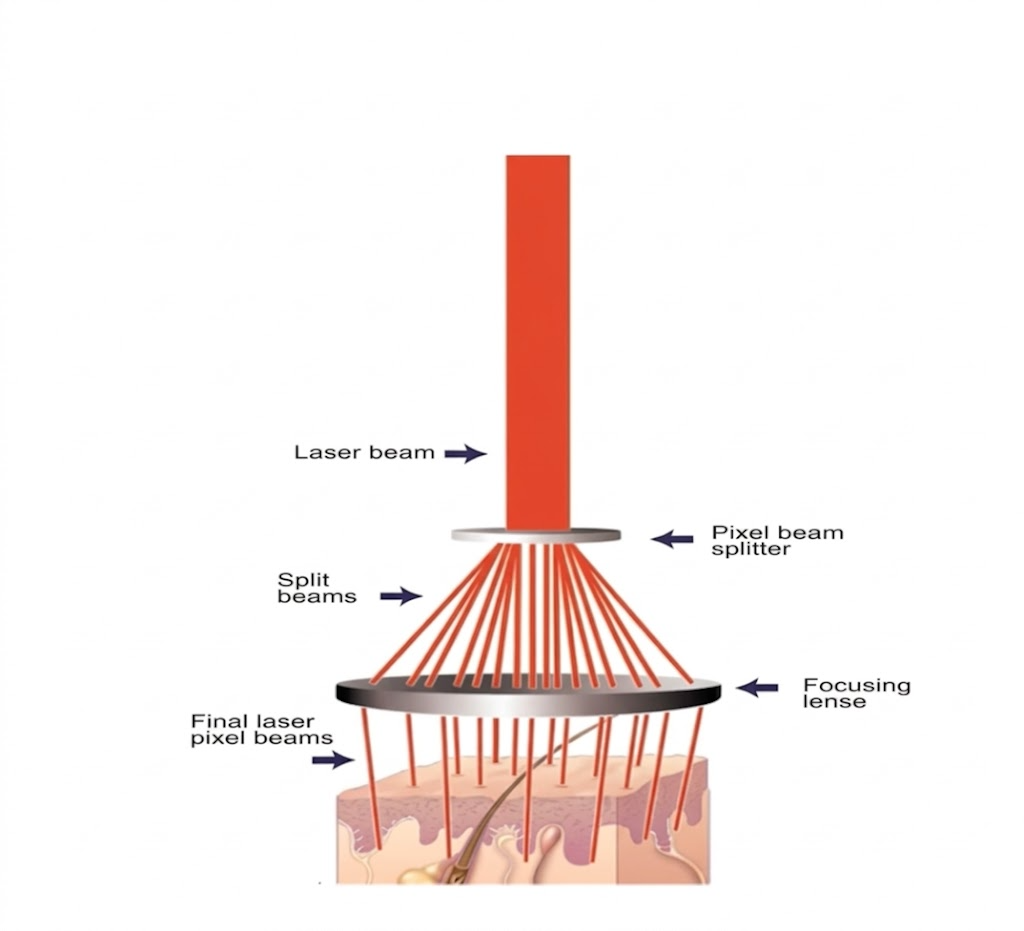
One beam becomes hundreds
A special fractional attachment splits the laser beam into hundreds of tiny pixel beams — spreading the energy precisely across the treatment area without damaging surrounding tissue.
2
Thousands of microscopic injuries
The pixel beams create a grid of tiny controlled micro-injuries in the soft palate, uvula, tonsils, and sides of the tongue — precisely where the vibration occurs during sleep.
3
Wound healing response
The body heals these microinjuries by producing new collagen — stronger, firmer collagen than was there before. Collagen production peaks at around one month.
4
Tissue tightens — snoring reduces
As the new collagen matures, the soft palate shrinks and firms. The throat opens. The tissue that was vibrating and causing snoring is now tighter, shorter, and far less likely to vibrate.
What the treatment feels like
During the procedure, most patients feel mild warmth or a light tingling. Many feel nothing at all. The session takes 5–10 minutes and requires no anesthesia. Afterward, the most common experience is a very mild sore throat that evening — similar to the feeling of coming down with a cold, but without the cold. It resolves within a day or two. Patients return to normal activity immediately.
Microneedling vs. laser snoring treatment
Microneedling (face)
- Tiny needles create microinjuries in skin
- Triggers new collagen production
- Skin tightens and lifts
- Can be quite painful
≈
Laser snoring treatment
- Fractional laser creates microinjuries in soft palate
- Triggers new collagen production
- Tissue tightens and firms
- Virtually painless — mild warmth at most
Same biological principle. Very different experience.

What to expect
The treatment timeline
Two sessions, spaced about a month apart, produce the best and longest-lasting results. An annual touch-up session keeps the results going year after year.
Day 1
Session 1
First session — 5 to 10 minutes
The fractional laser is applied to the soft palate, uvula, tonsils, and tongue sides. No anesthesia required. You leave the office immediately and resume all normal activities. That evening, a mild sore throat is possible — like the start of a cold, but it isn't one. Most patients notice a reduction in snoring within 1 to 5 days as initial tissue swelling subsides.
~4 wks
Session 2
Second session — best results
Collagen regeneration from the first session peaks at around one month. The second session builds on this response — adding a new round of collagen production on top of already-tightening tissue. Most patients achieve their best results after this second session. Results typically last 12 to 18 months.
Annual
Touch-up
Once-a-year maintenance
A single annual touch-up session keeps the results going. Most patients find the maintenance session even easier and more comfortable than the initial treatments as the tissue has already been conditioned. Many patients schedule their annual session as part of their regular dental care.
Part of the bigger picture
Snoring is often a symptom — not a standalone problem
For many patients, snoring laser treatment is a fast, effective solution. For others, snoring is one sign of a broader airway issue. Dr. Haller evaluates the full picture and can combine treatments for better, longer-lasting results.
Tonsil laser decontamination
Enlarged tonsils are a common contributor to snoring. Shrinking them with the CO2 laser — in the same visit — opens the airway further and enhances the effect of snoring treatment.
Nasal Release Therapy
If nasal obstruction is forcing mouth breathing and worsening snoring, NRT opens the nasal passages — making nasal breathing the easier default and reducing snoring from that upstream cause.
Tongue tie evaluation
A tongue tie causes low tongue posture — the tongue falls back during sleep and contributes to airway narrowing. If present, releasing it is the upstream fix that makes everything else work better.
Airway expansion
For patients who want a more permanent structural solution, epigenetic arch expansion widens the palate and airway — addressing the anatomical root cause of snoring and sleep-disordered breathing.
A note on sleep apnea
Laser snoring treatment reduces snoring effectively — but it is not a treatment for obstructive sleep apnea. If your snoring is accompanied by daytime sleepiness, gasping or choking episodes, or if a bed partner has witnessed pauses in your breathing, it's worth being evaluated for sleep apnea before or alongside snoring treatment. Treating the sound without treating the underlying obstruction leaves the more serious problem unaddressed. Dr. Haller is happy to discuss this at your consultation.
Frequently asked questions
What patients ask most
Does it hurt?
No. Most patients feel mild warmth or a light tingling during the procedure — many feel nothing at all. There is no anesthesia required. That evening, a very mild sore throat is possible — similar to the feeling of coming down with a cold. It is not a cold, and it resolves within a day or two. Patients return to all normal activities immediately after treatment.
How quickly will I notice results?
Most patients notice a reduction in snoring within 1 to 5 days after the first session. The second session, at around 4 weeks, builds on the first. Full results — as the new collagen matures — develop over the following weeks and typically reach their peak at around 6 to 8 weeks after the second session.
How long do results last?
Results typically last 12 to 18 months. An annual touch-up session — just one, just 5–10 minutes — maintains the results. Most patients find the touch-up session more comfortable than the original treatment, and many schedule it as part of their regular dental care.
Does insurance cover this?
No. Insurance companies classify snoring treatment as elective and do not cover it. Our practice is fee-for-service. We provide a superbill for your records. Payment is due at time of service.
Can I combine this with other treatments?
Yes — and for many patients, combining treatments produces better and longer-lasting results. Tonsil laser decontamination and snoring treatment can often be done in the same visit. NRT, tongue tie evaluation, and arch expansion address upstream causes that laser snoring treatment alone does not resolve.
I've been told I have a deviated septum. Will this help?
Laser snoring treatment addresses the soft tissue vibration in the throat — not nasal obstruction. If a deviated septum or nasal blockage is contributing to your snoring by forcing mouth breathing, NRT (Nasal Release Therapy) may be a more appropriate first step, or a complement to this treatment. Dr. Haller evaluates the full picture at every consultation.
I think I might have sleep apnea. Should I do this first?
If you have symptoms of sleep apnea — daytime sleepiness, witnessed pauses in breathing, gasping, or choking at night — it is worth being evaluated for sleep apnea before or alongside snoring treatment. Laser snoring treatment reduces snoring but does not treat sleep apnea. Dr. Haller will discuss this with you at consultation and recommend the appropriate sequence of care.